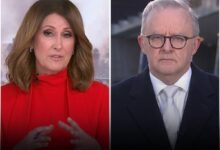
‘Weak and waffly’ Albanese ‘petrified’ of political action from Muslim community

‘Moral Clarity’ or Measured Diplomacy? Albanese Criticised Over Middle East Stance
As tensions in the Middle East intensify, Prime Minister Anthony Albanese is facing renewed criticism from commentators who argue Australia should more forcefully align itself with Israel and the United States.
The central charge: that Australia has not shown sufficient “moral clarity” in backing Israel’s military campaign against Hamas and in condemning Iran’s leadership.
The UN and Palestine Debate
Critics point to Australia’s voting record at the United Nations and its support for steps toward recognising Palestinian statehood as evidence of a shift in tone.
Supporters of the government counter that backing a two-state solution — Israel and a future Palestinian state — has long been bipartisan Australian policy, even if recognition has not yet formally occurred.


The government maintains that support for Israel’s right to exist and defend itself can coexist with support for Palestinian self-determination and humanitarian protections.
Iran and Escalation Concerns
In recent remarks, Albanese emphasised:
-
Preference for diplomatic solutions where possible
-
Concern about regional escalation
-
Hope for swift resolution of military actions
That language has been labelled by critics as “weak” or “waffly.”
The government describes it as responsible statecraft designed to avoid inflaming tensions in a volatile region.
Iran’s regime has been widely criticised internationally for human rights abuses and for backing armed groups across the Middle East. Australia has sanctioned Iranian individuals and entities, and parts of Iran’s security apparatus — including the Islamic Revolutionary Guard Corps (IRGC) — are subject to sanctions regimes. Legal designations, however, operate within specific statutory frameworks and are not triggered by rhetoric alone.
Domestic Tensions
The debate has intensified following reports that some religious institutions in Australia may hold memorial events related to Iran’s former leadership.
That raises complex legal and social questions:
-
Australia protects freedom of religion and expression.
-
Support for listed terrorist organisations is a criminal offence.
-
Whether specific conduct breaches the law depends on facts and legal thresholds assessed by authorities.
Government leaders must navigate condemning authoritarian regimes abroad while maintaining social cohesion at home.
The Broader Political Question
At heart, this dispute is about leadership style and foreign policy philosophy:
-
Should Australia mirror the forceful rhetoric of US leaders such as Donald Trump?
-
Or should it maintain a more measured tone reflecting its middle-power status and regional diplomatic priorities?
Critics frame the moment as a binary struggle between “good and evil.”
Governments typically frame foreign policy in terms of national interest, alliance management and risk mitigation.
A Difficult Balance
Australia is a longstanding ally of the United States and maintains diplomatic ties across the Middle East. Its leaders routinely balance:
-
Alliance solidarity
-
International law considerations
-
Domestic social harmony
-
Long-term strategic interests
Whether voters prefer sharper rhetoric or cautious diplomacy is ultimately a political judgment.
What is clear is that as global conflicts intensify, scrutiny of Australia’s stance — and the language used to describe it — will only increase.