SHOCK ROW AFTER ANN WIDDECOMBE’S DEATH: James Dreyfus Defends Her Against “Bigotry” Claims — But His Final Point Has Reignited a Furious Debate
SHOCK ROW AFTER ANN WIDDECOMBE’S DEATH: James Dreyfus Defends Her Against “Bigotry” Claims — But His Final Point Has Reignited a Furious Debate
Just days after the shocking death of Ann Widdecombe, a bitter public argument has erupted over how the former MP should be remembered—and whether disagreement rooted in religious belief should automatically be condemned as hatred.
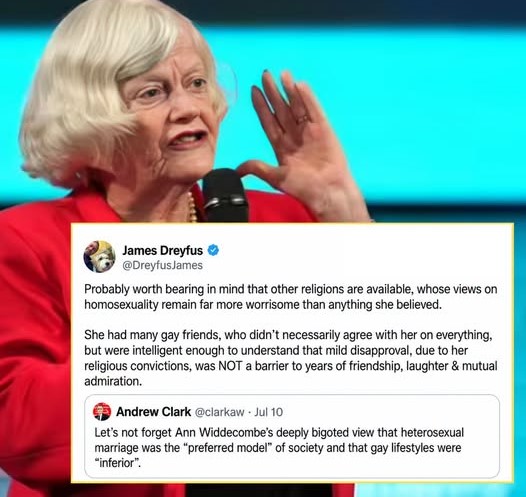
Actor James Dreyfus has stepped into the controversy after journalist Andrew Clark criticised Widdecombe’s past views on homosexuality. Rather than remaining silent, the openly gay actor issued a forceful defence of the late politician, drawing a distinction between opposing someone’s beliefs and denying their basic humanity.
His intervention has divided opinion, with some praising him for defending friendship across ideological boundaries, while others insist that Widdecombe’s political record had real consequences for LGBT people and cannot simply be dismissed as “mild disapproval.”
But behind the heated debate lies a more complicated question: Can someone hold deeply controversial religious beliefs while still maintaining genuine affection and respect for the people whose lives those beliefs concern?
James Dreyfus responds to the criticism
The controversy began when Clark condemned Widdecombe’s historical position on homosexuality. Dreyfus responded on X by suggesting that her beliefs should be considered within a wider religious context.




“Probably worth bearing in mind that other religions are available, whose views on homosexuality remain far more worrisome than anything she believed,” the actor wrote.
It was his next statement, however, that attracted the greatest attention.
According to Dreyfus, Widdecombe had a number of gay friends who understood that friendship did not require complete agreement on every moral, religious or political question.
“She had many gay friends, who didn’t necessarily agree with her on everything,” he wrote, adding that they were capable of recognising that her religiously motivated “mild disapproval” did not prevent “years of friendship, laughter and mutual admiration.”
For Dreyfus, the disagreement was apparently not proof of personal hatred. Instead, it was an example of people holding conflicting convictions while continuing to value one another as individuals.
His words immediately reignited an argument that has followed Widdecombe throughout much of her public life.
Was it merely religious disagreement—or something more serious?
Widdecombe’s defenders have frequently portrayed her as a woman of uncompromising Christian conviction. They argue that she was consistent in applying her beliefs and did not reserve her moral criticism exclusively for gay people.
Her critics see the matter very differently.
During her long political career, Widdecombe opposed same-sex marriage and took positions against several reforms sought by gay-rights campaigners. Her views were therefore not confined to private religious reflection; they entered public debate through speeches, interviews and parliamentary decisions.
For many LGBT campaigners, that distinction matters enormously. They argue that it is one thing for a private citizen to hold a personal belief about marriage or sexuality, but another for an influential politician to support policies affecting the rights and lives of millions of people.
Widdecombe’s record consequently remains deeply controversial. She opposed equalising the age of consent and later resisted the introduction of same-sex marriage, maintaining that the state should continue to favour heterosexual marriage as its preferred model. Her socially conservative positions repeatedly brought her into conflict with LGBT organisations and equality advocates. Reuters’ account of her political record described her as a longstanding opponent of several LGBT-rights reforms.
That is why Dreyfus’s choice of the phrase “mild disapproval” has become so contentious.
Supporters understood it as a description of Widdecombe’s personal behaviour toward gay friends: she could disagree with aspects of their lives without treating them cruelly or refusing their friendship.
Critics, however, contend that the phrase risks understating the effect of the political positions she promoted. They argue that being friendly toward individual gay people does not automatically erase opposition to their legal equality.
The result is a debate in which both sides appear to be talking about different aspects of the same person.
One side is describing Ann Widdecombe the friend. The other is judging Ann Widdecombe the politician.
Dreyfus challenges the idea that disagreement equals hatred
Dreyfus, who is openly gay, has long argued that people should be capable of disagreeing over moral, cultural and religious questions without immediately branding one another as hateful.
His defence of Widdecombe reflects that broader principle.
At the heart of his argument is the idea that friendship does not require ideological conformity. Two people can disagree fundamentally about religion, marriage, sexuality or politics while still recognising each other’s humanity.
According to this view, demanding complete agreement as a condition of friendship creates a society in which people increasingly live inside isolated political and cultural camps. Every disagreement becomes a test of loyalty, and every unpopular belief is treated as evidence of personal malice.
Dreyfus appears to believe Widdecombe’s gay friends understood the distinction. They knew what she believed, disagreed with her and nevertheless continued sharing affection, humour and mutual respect with her.
His critics respond that tolerance should not be demanded only from the people whose rights are being questioned. While friendship across differences may be admirable, they argue, LGBT people should not be expected to regard opposition to their equality as a harmless intellectual disagreement.
That tension explains why the actor’s remarks have attracted such powerful reactions.
A woman whose public and private reputations often collided
Ann Widdecombe was never a politician who attempted to soften her beliefs to appeal to a broader audience.
During her years in Parliament, she became known for her combative debating style, social conservatism and willingness to defend positions that were becoming increasingly unpopular. She served as a Conservative MP from 1987 until 2010 and held ministerial roles, including prisons minister, before later becoming a Brexit Party MEP and a prominent Reform UK figure.
Her Christian faith was central to her identity. She converted to Roman Catholicism in the 1990s and frequently spoke about political questions through the lens of religious morality.
To critics, this made her rigid, judgmental and hopelessly out of step with social change. To supporters, it made her unusually honest in a political world where public figures often modify their beliefs according to opinion polls.
Yet the private descriptions of Widdecombe were frequently more complicated than the public caricature.
People who knew her spoke of humour, generosity and an ability to enjoy the company of individuals whose political views differed sharply from her own. Her unexpected popularity on television—particularly during Strictly Come Dancing—revealed a self-deprecating and playful side that many viewers had never associated with the formidable former minister.
This contrast formed a central part of her public image: a politician capable of provoking fury through her words, yet a private individual remembered warmly by many who disagreed with her.
Dreyfus’s defence focuses squarely on that apparent contradiction.
He is not claiming that Widdecombe supported gay rights. Nor is he denying that gay people found her views painful or offensive. Instead, he appears to be arguing that her beliefs did not tell the complete story of how she treated the gay people she personally knew.
Whether that distinction is convincing remains at the centre of the controversy.
The timing has made the dispute even more explosive
The debate comes amid an active investigation into Widdecombe’s violent death at her home in Haytor, Devon.
Police were called to the property at approximately 11.40am on Thursday, 9 July, where the 78-year-old former MP was found dead with serious injuries. Investigators believe the attack occurred at around 12.30pm the previous day.
A 26-year-old man who was initially arrested on suspicion of murder was subsequently released and is no longer part of the investigation. A second man, aged 28, was later arrested in South Yorkshire.
The police initially urged the public not to speculate about a political or terrorist motive. However, the investigation has since undergone a significant development.
Counter Terrorism Policing is now leading the inquiry after officers said “new information and evidence” had emerged. The 28-year-old man has been re-arrested on suspicion of the commission, preparation or instigation of acts of terrorism. He remains a suspect, and the arrest does not establish guilt or confirm the precise motive behind Widdecombe’s death. Devon and Cornwall Police’s latest official statement stresses that investigators are still working to establish the full circumstances.
It is therefore essential not to connect Dreyfus’s remarks, Widdecombe’s views on homosexuality or the online debate to the motive for her killing unless investigators produce evidence supporting such a link.
The actor’s intervention concerns how Widdecombe should be remembered. The criminal investigation concerns who killed her and why. At this stage, those remain separate issues.
Can friendship exist across a profound moral divide?
The argument surrounding Dreyfus’s comments is unlikely to disappear quickly because it touches on a much larger cultural divide.
One perspective holds that friendship requires accepting people despite disagreement. Under this view, Widdecombe’s gay friends were not betraying themselves by maintaining a relationship with her. They were demonstrating the maturity to distinguish an individual’s religious beliefs from their complete character.
The opposing perspective argues that some disagreements are too consequential to be treated like differences in taste. If a politician actively opposes equal rights, critics say, those affected cannot be expected to regard that position as merely a private conviction.
Both perspectives raise uncomfortable questions.
Does knowing and liking gay people prove that someone is not prejudiced? Not necessarily.
Does holding a traditional religious belief mean that every friendship with a gay person must be insincere? Not necessarily.
Can personal kindness coexist with political positions that cause real pain? Widdecombe’s life suggests that it can—and that is precisely what makes her legacy so difficult to reduce to a single description.
The battle over Ann Widdecombe’s legacy has only begun
In death, as in life, Ann Widdecombe remains a figure capable of provoking admiration and anger in equal measure.
Her supporters remember her as fearless, funny and faithful to her convictions. Her critics remember a powerful politician who repeatedly opposed changes that brought greater legal equality to LGBT people.
James Dreyfus has now challenged the public to leave room for both disagreement and affection. His defence suggests that Widdecombe’s friendships should count as evidence that her private relationships were more nuanced than her political reputation implied.
But for those who lived through the battles over equal rights, personal warmth may not be enough to outweigh the positions she championed.
Perhaps the most uncomfortable truth is that both versions of Ann Widdecombe can exist simultaneously. She could be a loyal friend to gay people while holding beliefs many gay people considered deeply damaging. She could create years of “laughter and mutual admiration” while remaining politically opposed to same-sex marriage.
Dreyfus’s intervention has not settled that contradiction. Instead, it has exposed it more clearly than ever.
And as Britain continues to mourn Widdecombe while police investigate the circumstances of her death, the argument over what she truly represented—and how history should remember her—is only becoming more intense.