Sam Neill dies suddenly at 78, leaving behind far more than the man who survived Jurassic Park
Sam Neill, the New Zealand actor who became one of the most familiar and quietly beloved faces in world cinema, has died suddenly in Sydney at the age of 78.
His family announced the news in a statement shared on his official Instagram account, describing the loss as “sudden and unexpected”.
Neill died on Monday, July 13, surrounded by family at St Vincent’s Private Hospital in Sydney.
The circumstances have made his death particularly shocking.
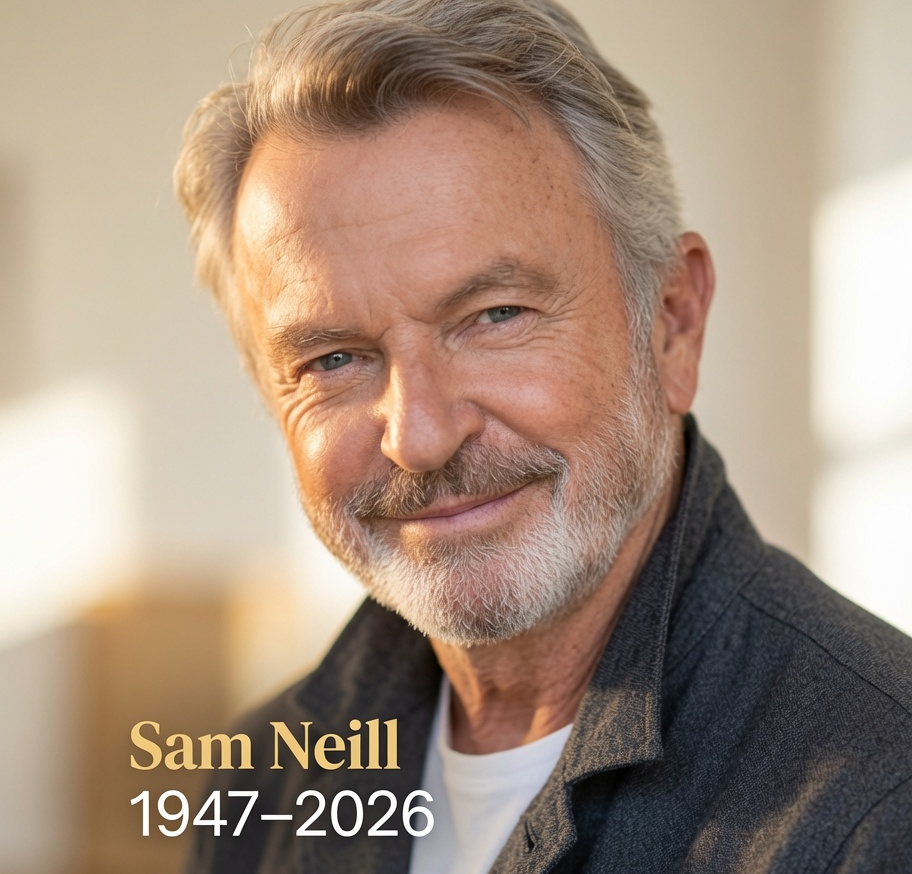




Only months earlier, Neill had spoken publicly about being cancer-free after a five-year battle with a rare form of blood cancer. His family’s statement made clear that he remained cancer-free when he died.
Further information will be shared by the family at a later time.
For millions of moviegoers, Sam Neill will always be the man in the dusty hat staring upwards as dinosaurs returned to the Earth. But reducing his career to Jurassic Park would miss almost everything that made him remarkable.
Neill spent more than half a century moving between New Zealand, Australian, British and Hollywood productions with an ease few actors ever achieved.
He could play a romantic lead without becoming sentimental.
He could play a villain without reducing the character to a caricature.
He could carry a blockbuster, disappear into an art film, bring dry humour to a television role and then return home to talk about wine, animals and life with the relaxed manner of someone who never seemed particularly impressed by his own fame.
His family’s description of him as wry, dry, thoughtful and laconic will be immediately recognisable to audiences who followed Neill away from the screen as closely as they watched him on it.
That personality became part of his public appeal.
Neill was a Hollywood star who rarely behaved like one.
Born Nigel John Dermot Neill in Northern Ireland in 1947, he moved to New Zealand with his family as a child.
He later adopted the name Sam, beginning a life that would eventually make him one of New Zealand’s most internationally recognised actors.
His breakthrough came with Roger Donaldson’s 1977 film Sleeping Dogs.
The political thriller occupies an important place in New Zealand cinema, and Neill’s performance helped establish him as a serious screen actor at a time when the country’s modern film industry was still developing its international identity.
Two years later came Gillian Armstrong’s My Brilliant Career.
As Harry Beecham opposite Judy Davis’s Sybylla Melvyn, Neill became part of one of Australian cinema’s defining films.
The role also began a relationship with Australian audiences that would continue for decades.
Australians often treated Neill as one of their own.
He was not Australian, and his identity remained deeply connected to New Zealand, but his work became so embedded in Australian film and television that the description “honorary Aussie” never felt particularly forced.
He appeared in stories Australians recognised.
He worked with Australian directors and actors.
He understood the understated rhythm of local screen performance.
And he possessed the kind of dry delivery that crossed the Tasman without needing translation.
Neill’s early international career quickly demonstrated the breadth that would define his work.
In 1981, he played Damien Thorn in Omen III: The Final Conflict.
That same year he appeared in Andrzej Żuławski’s Possession, the psychologically ferocious horror drama starring Isabelle Adjani.
The two roles alone demonstrated his unusual range.
Neill could bring cold authority to supernatural horror and then operate inside the emotional chaos of one of European cinema’s most unsettling cult films.
He was never easily categorised.
That became one of the great strengths of his career.
Neill received international recognition for his performance as Sidney Reilly in the television miniseries Reilly, Ace of Spies.
He played Michael Chamberlain in Evil Angels, known internationally as A Cry in the Dark, opposite Meryl Streep.
He starred in Phillip Noyce’s tense psychological thriller Dead Calm with Nicole Kidman and Billy Zane.
He appeared in The Hunt for Red October.
Then, in 1993, Steven Spielberg released Jurassic Park.
Everything changed.
Neill’s Dr Alan Grant became one of the defining characters of the blockbuster era.
Grant was a palaeontologist, but he was not written as a conventional action hero.
He did not arrive on Isla Nublar with weapons, military training or a desire to save the world.
He was a scientist fascinated by creatures that had been dead for millions of years.
Then he was forced to survive among them.
Neill’s performance gave the film an essential human centre.
His reaction to seeing a living Brachiosaurus helped sell the impossible premise before computer-generated dinosaurs had become familiar to audiences.
The wonder on Grant’s face mattered because Neill made the character believable.
Later, when the park collapsed into chaos, the same understated quality made Grant’s fear and determination equally convincing.
Spielberg’s film became a global phenomenon.
Dr Alan Grant became permanently associated with Neill.
He returned to the role in Jurassic Park III in 2001 and again in Jurassic World Dominion in 2022, reuniting with Laura Dern and Jeff Goldblum.
For younger generations, those films repeatedly introduced Neill to new audiences.
But while Jurassic Park made him a global star, Neill never allowed the franchise to consume his career.
In the same year Spielberg’s dinosaurs dominated cinemas, Neill appeared in Jane Campion’s The Piano.
As Alisdair Stewart, he played a very different man from Alan Grant.
The film, starring Holly Hunter and Harvey Keitel, became one of the most acclaimed productions associated with New Zealand cinema and won the Palme d’Or at Cannes.
Neill continued moving between genres.
He appeared in John Carpenter’s In the Mouth of Madness, Paul W.S. Anderson’s science-fiction horror film Event Horizon, the Australian comedy Death in Brunswick and the much-loved The Dish.
Australian audiences developed a particular affection for The Dish, in which Neill played Cliff Buxton, the fictionalised director of the Parkes Observatory during the Apollo 11 moon landing.
The performance captured something Neill did exceptionally well.
He could project competence without arrogance.
He made intelligent characters feel human rather than theatrical.
He understood how much could be communicated through a pause, a glance or a line delivered slightly more quietly than expected.
That restraint was central to his acting.
Neill rarely seemed to be asking an audience to notice the performance.
He trusted viewers to come to him.
His later television work introduced another generation to his talent.
In Peaky Blinders, he played Chief Inspector Chester Campbell, the ruthless police officer sent to Birmingham to recover stolen weapons and crush criminal networks.
Neill’s Campbell was severe, dangerous and increasingly consumed by his own obsessions.
The role placed him opposite Cillian Murphy’s Tommy Shelby during the series’ formative years.
Following Neill’s death, his contribution to the early success of Peaky Blinders was remembered as a key part of establishing the drama’s world and intensity.
Yet there was always another Sam Neill visible beyond the actor.
He was a writer.
He was a wine producer.
He owned Two Paddocks, the Central Otago vineyard he founded in New Zealand.
His social media presence became unexpectedly popular because it offered something rare in celebrity culture: genuine eccentricity without an obvious marketing strategy.
Neill shared animals, farming life, music, wine and fragments of his thoughts.
His pigs and other animals became familiar to followers.
The humour was gentle and often self-deprecating.
He appeared to enjoy the absurdity of life.
That public warmth became especially important after Neill revealed his cancer diagnosis.
In 2023, while promoting his memoir Did I Ever Tell You This?, he disclosed that he had been diagnosed with stage-three angioimmunoblastic T-cell lymphoma, a rare blood cancer.
Neill had first experienced swollen glands while promoting Jurassic World Dominion in 2022.
Treatment followed.
His first chemotherapy regimen eventually stopped working.
He then received another drug treatment that put the cancer into remission.
Neill discussed the illness with extraordinary openness, but he repeatedly resisted allowing cancer to become his identity.
He did not want his memoir to be understood simply as a cancer book.
He wrote because, during treatment, he found himself with time and a desire to tell stories from his life.
The resulting book was characteristically Neill.
It moved through childhood, acting, friendship, filmmaking and mortality without abandoning humour.
His approach to illness was neither falsely heroic nor consumed by despair.
He acknowledged fear.
He acknowledged uncertainty.
But he continued working and living.
In late April this year, Neill announced that he was cancer-free after five years of treatment.
That is why news of his sudden death has carried an additional shock.
His family’s statement specifically said he remained cancer-free.
The clarification is important.
Neill’s public battle with blood cancer was so widely known that many people immediately associated reports of his death with the disease.
His family has not yet provided a detailed cause of death.
What they have said is that the loss was sudden and unexpected.
They have also expressed gratitude for the care he received at St Vincent’s Private Hospital in Sydney.
Tributes quickly spread across Australia, New Zealand and the international entertainment industry.
Prime Minister Anthony Albanese joined those remembering Neill, reflecting the unusual place the actor occupied in Australian public life.
He was a New Zealand screen legend who became deeply woven into Australia’s cultural memory.
There are actors who become famous because of one role.
There are actors who become respected because of a body of work.
Neill achieved both.
Alan Grant gave him a character recognised almost anywhere in the world.
But Sleeping Dogs, My Brilliant Career, Possession, Evil Angels, Dead Calm, The Piano, The Dish and Peaky Blinders demonstrated why filmmakers continued returning to him for decades.
His career did not depend on reinvention because Neill was never trapped in a single type of role.
He could be sinister.
Romantic.
Authoritative.
Broken.
Funny.
Ordinary.
He could stand beside a computer-generated Tyrannosaurus rex in the biggest film in the world and somehow remain the person audiences watched.
That is more difficult than it sounds.
Neill’s death also marks the loss of a particular kind of Australasian screen figure.
His generation helped carry Australian and New Zealand filmmaking into a much larger international conversation.
They built careers before streaming platforms erased many of the old boundaries between local and global entertainment.
Neill could work in Wellington, Sydney, London or Hollywood without appearing to belong exclusively to any of them.
But he never lost the qualities that made audiences on this side of the world claim him.
The dryness.
The understatement.
The suspicion of unnecessary fuss.
The ability to be serious without becoming solemn.
Perhaps that is why the reaction to his death feels so personal.
Many viewers never met Sam Neill.
They simply spent decades with him.
They saw him in the Australian films their parents loved.
They watched him confront dinosaurs as children.
They discovered his darker work as adults.
They met him again on television.
Then they followed an older Neill online, surrounded by animals and vines, talking about cancer, acting and the strange business of being alive.
He aged in public without turning ageing into a performance.
Even during his illness, Neill remained interested in the world beyond himself.
That may be the quality his family’s statement captures best.
Dignity.
Not the polished dignity of a carefully managed celebrity image.
The quieter dignity of a man who understood that life could become frightening and absurd, sometimes at the same time.
Sam Neill survived Isla Nublar.
He survived decades in an industry famous for discarding actors.
He survived a rare blood cancer and lived to tell people he was cancer-free.
His death at 78 was sudden and unexpected.
His career was anything but unfinished.
Across more than five decades, Neill built a body of work stretching from the emergence of modern New Zealand cinema to one of Hollywood’s greatest blockbusters and the streaming-era rediscovery of prestige television.
For New Zealand, he was one of its great international actors.
For Australia, he was the honorary local who kept appearing in our stories until it became difficult to imagine the screen without him.
For the rest of the world, he was Dr Alan Grant.
And for the people who followed the man beyond the films, he was Sam: wry, dry, thoughtful, laconic and apparently never too important to share the frame with a pig.
That breadth was his gift.
It is why his sudden death has travelled so quickly around the world.
And it is why one famous role, even one involving the most famous dinosaurs in cinema history, was never going to be big enough to contain him.