Please don’t let this be the end…’ — fans are in tears as Denise faces the toughest challenge of her life

Denise Fox (Diane Parish) has faced some hellish times during her twenty year tenure in EastEnders.
Abusive relationships, the tragic death of her beloved fiancé, engaged to a serial killer who imprisoned her and faked her death, poverty and starvation, a love triangle, being involved in a murder and the resulting psychosis…
Yup, it’s incredibly safe to say our Denise has run the full gauntlet of soap suffering, but her upcoming battle could prove to be her most challenging yet.
Two weeks ago, as she sat alone in a doctors office, Denise was diagnosed with acute myeloid leukaemia (AML), a fast-growing and aggressive type of blood cancer.
Last week, on the ‘night that changes everything’, viewers saw Denise struggle to deal with the enormity of her circumstances.


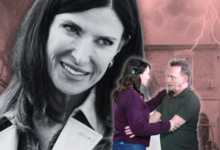

As the other residents of Albert Square bore witness to the drama that was Ross Marshall (Alex Walkinshaw) and Vicki Fowler’s (Alice Haig) wedding, Denise retreated to the safety of Fox & Hair.

There, she was discovered by Yolande Trueman (Angela Wynter).
Unable to contain her emotion any longer, Denise utterly broke down to Yolande, riddled with terror over what the news means for her.
As a consultant called Denise to return to the hospital immediately to begin the treatment she desperately needs, she denied this in order to support daughter Chelsea (Zaraah Abrahams), who’s son Jordan Fox (Jahsaiah Williams) had been knocked down by Ian Beale (Adam Woodyatt).
Yolande continued to gently push her to open up to her family and, eventually, she told her partner, Jack Branning (Scott Maslen), and the social media floodgates opened again with fans still terrified for Denise.
An expert weighs in on the story

The CEO of Blood Cancer UK, Helen Rowntree spoke out on the importance of Denise’s story.
‘It’s been a privilege advising the EastEnders team at the BBC to ensure Denise’s storyline reflects the real experiences of people living with blood cancer and those who care for them.
‘Blood cancers, which include leukaemia, lymphoma and myeloma, do not discriminate yet experiences and outcomes can vary significantly, including by ethnicity.
‘Being Black and living with an aggressive blood cancer like acute myeloid leukaemia can bring additional challenges.
‘We hope viewers gain a greater understanding of blood cancer’s impact and we’re pleased this issue is being highlighted on a powerful platform, helping make a ‘hidden’ cancer more visible.’