‘I Will Not Abandon Him’: Pauline Hanson Slams Disgraceful Arrest of Ben Roberts-Smith as Political Divide Deepens Over War Hero’s Fate
The Australian political landscape has been rocked by a seismic shift following the arrest of Ben Roberts-Smith VC, MG, with One Nation leader Pauline Hanson delivering a scathing critique of the authorities’ tactics. In a move that has further polarized a nation already grappling with the legacy of its longest war, Senator Hanson has vowed to remain “steadfast” in her support for the embattled SAS hero, labeling the manner of his detention as nothing short of “disgraceful.” As the Victoria Cross recipient begins a high-stakes week behind bars, the battle lines are being drawn between those who view him as a victim of institutional betrayal and those who see his arrest as a long-overdue victory for international law.
The controversy centers on the dramatic events at Sydney Airport last Tuesday, where Roberts-Smith was taken into custody by Australian Federal Police (AFP) officers immediately upon his arrival from Brisbane. Traveling with his twin 15-year-old daughters, the 47-year-old former corporal was met not with the quiet surrender often afforded to high-profile figures, but with a public interception that has sparked outrage across the patriotic right. Senator Hanson, never one to shy away from nationalistic fervor, took to social media to express her indignation, directly addressing the emotional toll on the Roberts-Smith family and the broader military community.

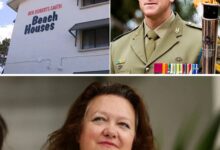
Defiant Stance: One Nation leader Pauline Hanson has vowed not to abandon the Victoria Cross recipient, criticizing the ‘disgraceful’ nature of his public arrest.
“Ben, his immediate and broader defence family need the Australian people’s support right now and I will not abandon him like so many other politicians,” Hanson wrote in a post that quickly went viral among her supporters. Her critique was not limited to the optics of the arrest; she also highlighted the staggering financial and temporal costs of the investigation. According to the Senator, the AFP and the Office of the Special Investigator (OSI)—an anti-war crimes taskforce launched in 2021—have spent upwards of $300 million over a ten-year period to secure these charges. For Hanson and many within the veteran community, this expenditure represents a targeted crusade against a man who embodies the ANZAC spirit, rather than a pursuit of impartial justice.



The charges leveled against Roberts-Smith are as grave as they are specific. The AFP has confirmed five counts of “war crime – murder,” each carrying a maximum penalty of life imprisonment. These allegations stem from three separate incidents during his deployments in Afghanistan: a death at Kakarak in Uruzgan Province on April 12, 2009; an incident in Darwan on September 11, 2012; and two deaths in Syahchow on October 20, 2012. The prosecution alleges that Roberts-Smith either intentionally caused these deaths or “aided, abetted, counselled or procured” others to do so. To the legal establishment, these are necessary steps to uphold the Geneva Convention; to his defenders, they are “fog of war” decisions being picked apart by bureaucrats a decade after the fact.
The reaction to the arrest has exposed a cavernous rift in the Australian Senate. While Hanson has positioned herself as a shield for Roberts-Smith, Greens Senator David Shoebridge reacted with stark brevity, posting a single word—”Good”—on social media platform X. This ideological clash highlights the broader cultural conflict currently unfolding in Australia. On one side, the “Patriotic Aussies” and One Nation supporters see a hero being sacrificed on the altar of political correctness. On the other, progressives see a necessary reckoning for alleged atrocities that they believe have tarnished the reputation of the Australian Defence Force (ADF).
Senator Hanson’s concerns regarding the legal process are particularly pointed. She noted that Roberts-Smith faces a grueling seven-day wait in jail before his bail review on April 17th. Under the specific legal framework governing these charges, he may only get one shot at bail. “If that application fails, they can hold him for 2 years,” Hanson warned, emphasizing the perceived imbalance of power between a single individual and a government taskforce backed by hundreds of millions of taxpayer dollars. This “one-strike” bail rule has become a rallying cry for activists who believe the system is being rigged to force a confession or break the morale of the decorated soldier.
In contrast to the heated rhetoric of the Senate crossbench, the government’s response has been more measured but equally controversial. A spokesperson for the authorities, Ms. Barrett—who is currently under fire for her handling of recent security threats and her focus on “hate speech” legislation—attempted to frame the charges as an isolated issue. In a formal statement, she claimed the expected charges were “confined to a very small section of our trusted and respected ADF.” While she thanked the “hardworking members of OSI and AFP” for their decade-long dedication, her comments did little to soothe the anger of those who feel the entire SAS Regiment is being unfairly maligned by the actions of a few prosecutors.
The genesis of this legal nightmare traces back to 2017, when investigative journalists from Nine Entertainment (then Fairfax Media) first published allegations of war crimes. These reports were not merely the product of independent journalism; they were bolstered by the testimony of Liberal MP Andrew Hastie. As a former SASR comrade of Roberts-Smith, Hastie’s decision to give evidence against him during a high-profile defamation trial in 2023 was seen by many in the military as the ultimate betrayal of the “brotherhood.” That defamation trial ended in disaster for Roberts-Smith, with the Federal Court finding the allegations were “substantially true” based on a civil standard of proof—a finding that has since survived multiple appeals, including a failed bid to reach the High Court.
However, the narrative of a “righteous media” was severely compromised earlier this year when it was revealed that Nine Entertainment had paid $700,000 in a secret settlement to Roberts-Smith’s former mistress. This “hush money” payment allegedly occurred after she threatened to sue journalist Nick McKenzie for breaking a promise of anonymity and subpoenaing her against her will. For Senator Hanson and the “Free Ben” movement, this detail is the “smoking gun” that proves the media campaign was driven by unethical tactics and personal vendettas rather than a search for the truth. They argue that if the media had to pay nearly a million dollars to maintain their narrative, the foundation of their evidence is fundamentally suspect.
Despite the legal setbacks and the weight of the charges, the public’s memory of Roberts-Smith’s heroism remains a powerful force. Many Australians still vividly recall the citation for his Victoria Cross, earned during the Battle of Tizak in Kandahar Province in 2010. During that engagement, Roberts-Smith risked his life to storm two Taliban machine-gun positions that were pinning down his platoon. His bravery saved the lives of his fellow soldiers and remains one of the most storied acts of gallantry in modern Australian history. To his supporters, the idea that the same government that awarded him the nation’s highest honor is now seeking to imprison him for life is an irony too bitter to swallow.
As the April 17th bail hearing approaches, the pressure on the Australian legal system is mounting. The NWA and other patriotic groups have signaled that their support will only intensify if the bail application is denied. Senator Hanson has made it clear that she will not be silenced, framing the fight for Ben Roberts-Smith as a fight for the very soul of the Australian military. For many veterans, the message is clear: if the most decorated among them can be “abandoned” and “disgracefully arrested” in front of his children, then no one who has worn the uniform is truly safe from the reach of the bureaucrats.
The coming weeks will determine whether Ben Roberts-Smith remains a symbol of Australian heroism or becomes a cautionary tale of institutional overreach. With Pauline Hanson leading the charge in the political arena and tens of thousands of everyday Australians signing petitions and planning rallies, the “Free Ben” movement has transformed from a fringe cause into a mainstream cultural phenomenon. The eyes of the nation are now firmly fixed on the courtrooms and the corridors of power, waiting to see if the “Fair Go” still applies to those who have sacrificed the most for their country. Regardless of the legal outcome, the political divide sparked by this arrest is likely to persist for years, shaping the way Australia views its history, its heroes, and its future.
For now, Ben Roberts-Smith sits in a cell, caught between the machinery of a $300 million investigation and the unwavering support of a segment of the public that refuses to let his legacy be erased. As Senator Hanson aptly put it, the Australian people’s support is what is needed most right now—and for many, that support is non-negotiable. The fight for the Victoria Cross hero is no longer just about the events of 2009 or 2012; it is about the right of a soldier to be judged by his peers, not by a media cycle or a political agenda.