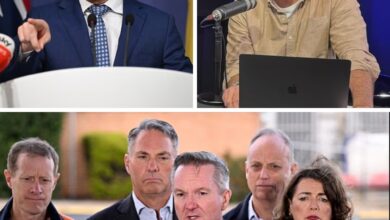
DAVE HUGHES CONTROVERSY DEEPENS — PRESSURE MOUNTS AS CLIP REFUSES TO DIE DOWN
 🚨 DAVE HUGHES CONTROVERSY DEEPENS — PRESSURE MOUNTS AS CLIP REFUSES TO DIE DOWN 🇦🇺🔥
What began as a controversial on-air remark has evolved into one of the most talked-about political conversations on Australian social media.
Days after comedian Dave Hughes’ comments about housing and taxation began circulating online, the clip continues to generate widespread discussion, with reaction videos, opinion pieces and political commentary keeping the debate alive long after its original broadcast.
Rather than fading from public attention, the controversy appears to have taken on a life of its own.
Millions of views across multiple platforms have transformed a brief television moment into a much broader discussion about housing affordability, taxation and growing public frustration over Australia’s cost-of-living pressures.
A Conversation Bigger Than One Clip
For many viewers, the discussion is no longer centred solely on what Hughes said.




Instead, attention has shifted toward why the comments appear to have resonated with so many Australians.
Supporters argue that Hughes simply voiced frustrations many people already feel about the housing market, rising property prices and the increasing difficulty younger Australians face in entering home ownership.
Some online users have described his comments as refreshing because they came from outside the political establishment, suggesting they reflected concerns that ordinary Australians discuss every day.
Others disagree.
Critics argue that reducing highly complex economic policy to short television exchanges or viral clips risks creating more heat than light. They contend that housing affordability, tax reform and investment policy involve difficult trade-offs that cannot be fully explained through brief media moments.
Housing Affordability Back in the Spotlight
The renewed attention has once again placed Australia’s housing market at the centre of public debate.
For years, governments, economists and industry groups have argued over the causes of rising house prices.
Population growth, planning restrictions, construction costs, interest rates, migration, housing supply and tax settings have all been identified as contributing factors.
Against that backdrop, Hughes’ comments have become a catalyst for broader public discussion, even among people who may disagree with his conclusions.
Many observers suggest the strong reaction says as much about current economic pressures as it does about the original remarks themselves.
Debate Over Capital Gains Tax
One of the most discussed aspects of the controversy has been the renewed focus on Capital Gains Tax policy.
Some commentators argue that changes to tax settings deserve serious public debate because of their potential effects on housing affordability and investment decisions.
Others caution that any reform could have unintended consequences, affecting retirement savings, investment confidence and the broader property market.
Economists continue to hold differing views on how much individual tax measures influence housing prices compared with broader supply and demand factors.
As a result, experts generally emphasise that meaningful reform requires careful analysis rather than relying solely on viral moments or social media discussion.
Social Media Keeps the Story Alive
Unlike many television controversies that disappear after a few news cycles, this one continues to gain new audiences.
Every repost, reaction video and podcast discussion introduces the clip to viewers who may never have seen the original broadcast.
Political commentators have noted that social media algorithms often reward emotionally charged content, allowing debates to continue long after traditional news coverage begins to fade.
That ongoing circulation has helped transform a single exchange into an extended national conversation.
Political Figures Stay Cautious
Despite the growing online attention, there has been little indication that government leaders intend to engage directly with the controversy.
Political observers suggest governments often avoid responding to celebrity commentary, preferring instead to communicate through official policy announcements and parliamentary debate.
Doing otherwise, some analysts argue, can risk amplifying controversies that might otherwise lose momentum.
Whether that approach succeeds remains to be seen.
A Nation Divided Online
Public opinion remains sharply divided.
Some Australians believe Hughes articulated concerns that have been ignored for too long, while others argue the discussion has become increasingly polarised and detached from the complex realities of economic policymaking.
Supporters continue to praise what they view as his willingness to speak candidly.
Critics maintain that celebrity influence should not replace informed public debate based on evidence and detailed policy analysis.
The intensity of the online discussion demonstrates how quickly entertainment figures can become central players in conversations traditionally dominated by politicians, economists and policy experts.
More Than Entertainment?
Perhaps the most striking aspect of the controversy is how rapidly it crossed the boundary between entertainment and politics.
A clip that began as a television moment is now being debated in political forums, shared by commentators across the ideological spectrum and discussed alongside broader questions about Australia’s economic future.
Whether the controversy ultimately influences public opinion—or simply reflects frustrations that already existed—remains uncertain.
What is clear is that the discussion has expanded well beyond one comedian or one television appearance.
For now, the viral clip continues to fuel conversations about housing, taxation and the pressures facing Australian households.
And as Australians continue debating the issues online, one question remains at the centre of the discussion:
Was this simply another viral media moment—or a sign that public frustration over housing and the cost of living is becoming an increasingly powerful force in Australia’s political conversation?