🚨 Anthony Albanese UNDER FIRE as ABC’s Michael Rowland GRILLS Him LIVE Over Bondi Attack

The Australian political landscape is witnessing one of the most severe crises of confidence in modern history. Prime Minister Anthony Albanese, who once prided himself on a leadership style of “listening and understanding,” has just endured a media nightmare, cornered by top journalists in a series of live television interviews.
The heart of the controversy is not just the bloody attack at Bondi Beach that left 15 people dead, but the government’s agonizingly slow—and arguably cruel—response in establishing a Royal Commission to investigate the incident. When a Prime Minister is interrogated on why grieving families were forced to become political activists to demand justice, it is clear that the government’s damage control has failed spectacularly.

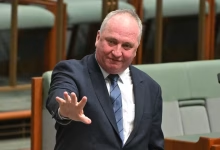
During the program Sunrise, the host delivered a direct question like a knife: “Jewish leaders have been saying that this delay forced families to emerge from their grief to actually become advocates for this Royal Commission. Is that something you regret?”.
Instead of a sincere apology, Mr. Albanese chose a typical political deflection. He claimed that this was actually “record time” for calling a Royal Commission. It is hard to believe: 15 people were murdered in the worst terrorist attack in decades, and the Prime Minister stands there bragging about his reaction speed.


The argument that “the last funeral was just two days ago” to justify three weeks of fierce resistance against investigation demands is an insult to those who were simply trying to bury their loved ones.

There is a massive difference between a careful leader and one paralyzed by political calculations. Mr. Albanese repeatedly insisted his government functions in an “orderly and considered” way. However, reality tells a different story.
When families who just lost loved ones have to write open letters and organize public campaigns just to get the government to do the right thing, that is not “orderly.” That is political cowardice disguised as thoughtfulness.
Opposition leader Sussan Ley delivered a fatal blow to the Prime Minister’s character: “If Mr. Albanese had shown the same determination to eradicate anti-Semitism over the last three years as he showed to avoid this Royal Commission over the last three weeks, the country might not be in such a terrible place right now”. This is no longer mere policy criticism; it is a complete character assassination of his leadership credibility.

One of the weakest points in Mr. Albanese’s responses was the contradiction between his words and actions. He insisted he was “listening and meeting with families,” but if you meet with grieving people and still refuse their most legitimate requests, that is not listening. It is merely going through the motions of a communication ritual to appease public opinion.
May you like




Why did it take 26 days from the deadliest mass shooting since Port Arthur to announce a high-level inquiry?. Why resist when 48% of Australians supported it according to polls?. Every answer Albanese gave sounded defensive, and the more he spoke, the more he exposed his indecisiveness in a true moment of crisis.

The Bondi tragedy has exposed an uncomfortable truth about Albanese’s leadership style: he is only decisive when the political winds are favorable. When faced with a genuine crisis requiring the courage to make a call with political risk, he froze.
The Royal Commission announcement should have happened immediately. Instead, he let it become a three-week “political nightmare” that severely damaged his personal credibility and caused further pain to victims already suffering. Even when he finally announced the Commission and tried to claim a political victory, the public saw right through the spin.

Anthony Albanese’s recent failure in these interviews is a costly lesson for any leader. The damage to his credibility is irreversible. No amount of rhetoric about “orderly processes” or “listening to communities” can erase the image of a government forced into action by the sheer pressure of victims’ families.
The question for Australian voters now is not just whether an investigation will take place, but whether we can trust a leader who consistently prioritizes political safety over justice for the people.